


1. Mermaid Diagram in a Code Block
The fastest native-ish route: add a code block, switch its language to Mermaid, and describe the structure as text — Notion renders the diagram live.
mindmap
  root((Product Launch))
    Marketing
      Content plan
      Paid ads
    Development
      Beta feedback
      Release checklist
One honest caveat searchers keep hitting: Mermaid's dedicated mindmap syntax is newer than the classic diagram types, and whether it renders depends on the Mermaid version Notion ships at the moment. If it doesn't render for you, the reliable fallback is a flowchart — graph TD with branches — which draws essentially the same tree.
Good for: quick structured sketches, version-controlled text. Bad for: drag-and-drop rearranging, visual styling, anything freeform.
2. Embed a Dedicated Mind Map Tool
Paste a share link from Miro, Whimsical, MindMeister, or Xmind and choose Embed — the live board renders inside your Notion page. You get a real mind-mapping canvas (drag, color, collapse branches) at the cost of your data living in another product, another account, and often another subscription.
Good for: workshop-style brainstorming, beautiful presentation. Bad for: keeping knowledge in one place — the map can't see or link your actual Notion pages.
3. Toggle-List "Mind Map" Templates
Most "Notion mind map templates" in the gallery are nested toggle lists or boards styled to feel radial. That's not a diagram — it's an outline. Which is fine: outlines are underrated, collapse cleanly, and stay searchable. Just know what you're getting: hierarchy without the picture.
4. Self-Related Database
The most "Notion-native" structural approach: one database of ideas with a self-relation ("Parent idea" / "Related ideas"). Every branch becomes queryable — filter by branch, roll up counts, build views per topic. You're modeling the mind map's structure without its visual. It also quietly builds real edges — which pays off in method 5.
5. Generate the Map From Your Workspace (IVGraph)
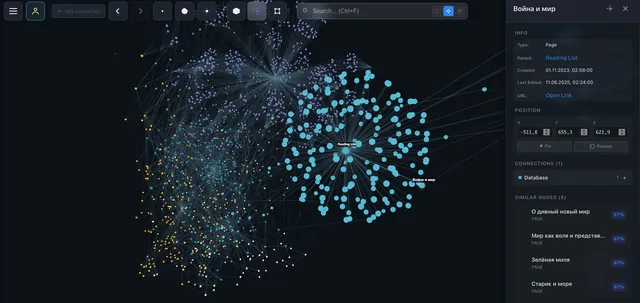
All four methods above share one limitation: you draw the map, and it only contains what you remembered to add. The fifth approach inverts this — IVGraph reads your workspace via the official API and renders every page, backlink, mention, and relation as an interactive 3D graph. It's a mind map you never draw: clusters emerge where your notes actually connect, hubs surface, forgotten branches float alone where you can see them.
Which One Should You Use?
| Method | Effort | Visual | Sees your real notes |
|---|---|---|---|
| Mermaid | Low | Static tree | No |
| Embed (Miro etc.) | Medium | Full canvas | No |
| Toggle template | Low | Outline only | Partially |
| Self-related DB | Medium | No picture | Yes (structure) |
| IVGraph | One-time connect | Interactive 3D | Yes (everything) |
Rule of thumb: brainstorming one idea → Mermaid or an embed. Mapping what you already know — a second brain, a research base, a team wiki — the hand-drawn approaches stop scaling, and the generated graph is the only one that keeps up.
FAQ
Does Notion have mind maps?
No native feature. Use Mermaid code blocks, embeds, templates, self-related databases, or an automatic workspace graph — compared above.
Why doesn't Mermaid's mindmap syntax render in my Notion?
The mindmap diagram type is newer than Mermaid's classics; rendering depends on the Mermaid version Notion currently ships. Use graph TD flowchart syntax as a dependable fallback — same tree, older syntax.
Mind map vs knowledge graph?
A mind map is designed by hand around one topic; a knowledge graph is generated from connections that already exist. First is a sketch, second is a survey — different jobs, both useful.