


Setup in 60 Seconds
claude mcp add --transport http notion https://mcp.notion.com/mcpApprove the OAuth prompt on the next run — done. Claude Code can now search your workspace, read pages as markdown, edit them, and query databases. All connection options, permissions, and the hosted-vs-self-hosted tradeoff are in our complete Notion MCP guide; the concept behind the whole setup is in What Is an LLM Wiki?
First, Teach It Your Workspace (CLAUDE.md)
The difference between a chatbot and a disciplined librarian is a conventions file. Claude Code reads CLAUDE.md from your project directory on every launch — put your workspace's rules there once, and every workflow below inherits them:
# My Notion workspace
- Sources live in "Inbox"; synthesized notes in "Knowledge Base"
- Always cite the source page when creating summaries
- Link related pages with @-mentions (they create backlinks)
- Never edit pages in "Archive"
- Projects DB relates to Tasks DB via the "Project" property
The Five Workflows
1. Ingest a source
"Read the article I just added to Inbox. Write a summary page in Knowledge Base: key claims, what's new versus what I already have, and @-mention every related page. Flag anything that contradicts my existing notes."
One source usually touches several pages — the summary, the index, and every page it links to. That's the compounding move manual note-taking never sustains.
2. Crosslink pass
"Find 5 pairs of pages in Knowledge Base that are related by meaning but not linked. For each pair, explain the connection in one sentence and add the @-mentions if I confirm."
This is where semantic understanding beats tags: Claude connects pages that share no keywords. Since @-mentions create backlinks, every confirmed pair enriches both pages at once.
3. Weekly review
"List everything that changed in my workspace this week: new pages, updated projects, stalled tasks. Then suggest 3 crosslinks and 1 summary worth updating."
Twenty minutes on Sunday replaces the review habit that dies by February. You confirm; the agent files.
4. Gap analysis
"Collect everything I know about [topic] across the workspace. Structure it as: covered well / covered thinly / not covered at all."
The "not covered" column is your research queue — extracted from your own notes instead of guessed.
5. File answers back
"That comparison you just produced — save it as a page in Knowledge Base, link the sources, and add it to the index."
Good answers shouldn't evaporate in chat history. Filed back, they become nodes the next question builds on — knowledge compounds instead of resetting.
Guardrails (Learned the Annoying Way)
- Confirm crosslinks before they're written. Models connect by word overlap sometimes — ours once linked "Python decorators" to "interior decor". Review-then-apply beats undo.
- Work in neighborhoods, not the whole base. Don't ask for "all 1800 pages" — scope to a database, a cluster, or a week. Context limits are real.
- Protect immutable zones. List archives and source-of-truth pages as read-only in CLAUDE.md.
- Remember the access model. Via MCP the agent has your permissions — everything you can touch, it can touch. Scope accordingly (details in the MCP guide's security section).
Close the Loop: Watch the Structure Change
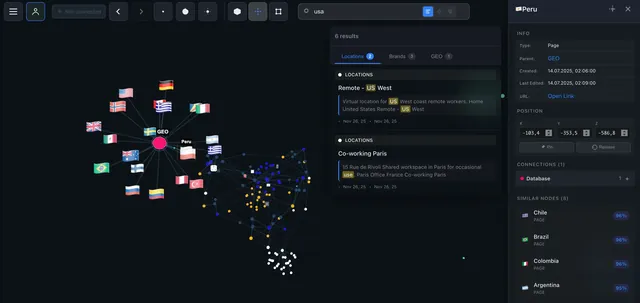
Text output can't answer the only question that matters over months: is the knowledge base actually getting more connected? A graph can. Open your workspace in IVGraph after a few ingest-and-crosslink cycles: clusters tighten, orphan pages get pulled into the network, hub pages emerge. It's the visual diff of your second brain — and agents can query the same structure through the IVGraph LLM API to pick their next crosslink candidates.
FAQ
How do I connect Claude Code to Notion?
claude mcp add --transport http notion https://mcp.notion.com/mcp, then approve OAuth. Full options in the MCP guide.
Claude Desktop or Claude Code?
Desktop for asking; Code for maintaining. The workflows above lean on CLAUDE.md persistence and multi-step execution — that's Claude Code territory.
How is this different from Notion AI?
Notion AI is in-place assistance; this is programmable maintenance. Own conventions, chained steps, and other tools (files, web, git) in the same loop. Many people run both.
Where does the second brain philosophy behind this come from?
From the LLM wiki pattern — the full story and architecture are in What Is an LLM Wiki? and our hands-on build log, LLM Wiki for Notion.