


Where the Idea Comes From
On April 4, 2026, Andrej Karpathy — co-founder of OpenAI and former head of AI at Tesla — published a short gist called llm-wiki.md. It isn't a tool or a repo: it's an idea file, written to be handed to your own LLM agent (Claude Code, Codex, and the like), which then works out a concrete implementation with you. Within months it had collected more than 5,000 stars, spawned community implementations, and made "LLM wiki" a term people actively search for.
The one-line pitch from the gist itself: "Obsidian is the IDE; the LLM is the programmer; the wiki is the codebase" — you stay in charge of choosing sources and asking questions, while the LLM does all the writing, filing, and cross-referencing.
LLM Wiki vs RAG: Compile Once vs Retrieve Forever
Most AI-plus-documents products work as RAG (retrieval-augmented generation): you upload files, and at question time the model fetches relevant chunks and improvises an answer. It works — but every question starts from zero. Nothing accumulates between queries.
An LLM wiki inverts this. When a new source arrives, the LLM reads it immediately, extracts what matters, and integrates it into an existing network of pages: updating entity pages, revising summaries, flagging contradictions with earlier material. Knowledge is compiled once and then kept current — so each answer starts from an already-synthesized picture rather than raw fragments.
| RAG | LLM wiki | |
|---|---|---|
| When synthesis happens | At query time, every time | At ingest time, once |
| Between questions | Nothing accumulates | Knowledge compounds |
| Contradictions | Rediscovered (or missed) | Flagged when a source is ingested |
| Good answers | Vanish into chat history | Filed back into the wiki as pages |
The Three Layers
The architecture in the gist is deliberately minimal:
- Raw sources — articles, papers, transcripts, data files. Immutable; the LLM reads them but never edits them.
- The wiki — LLM-generated, interlinked pages: summaries, entity pages, concept pages, comparisons. The LLM owns this layer entirely; you read it.
- The schema — a conventions file (CLAUDE.md, AGENTS.md) that tells the agent how the wiki is structured and how to behave when ingesting, answering, and maintaining. This is what turns a generic chatbot into a disciplined librarian.
Day to day, the wiki runs on three operations: ingest (drop in a source, the LLM integrates it — a single article can touch 10–15 pages), query (ask questions; good answers get filed back as new pages), and lint (a periodic health check for contradictions, stale claims, and orphan pages with no inbound links).
LLM Wiki vs Second Brain vs Knowledge Base
The terms overlap, and the search results confuse them constantly. The clean way to separate them:
| Term | What it is | Who maintains it |
|---|---|---|
| Knowledge base | Any organized store of information | Whoever bothers to |
| Second brain | A personal practice of capturing and organizing what you learn | You |
| LLM wiki | A knowledge base the LLM compiles and keeps current | The LLM |
That last column is the whole story. People abandon wikis and second brains because the bookkeeping — updating cross-references, reconciling old claims with new sources — grows faster than the value. The LLM doesn't get bored, which is why this pattern sticks where manual systems quietly die.
How to Build One
Three practical routes, depending on where your knowledge already lives:
- Markdown files + Obsidian — Karpathy's original setup. A folder of sources, a folder of wiki pages, a CLAUDE.md with conventions, and an agent in the terminal. Obsidian's clipper gets articles in; its graph view shows the shape of what's growing.
- Notion + MCP — if your notes and databases already live in Notion, you don't need to migrate anything: connect an agent through Notion's MCP server and let it read and write pages directly. We documented this end to end in LLM Wiki for Notion: Claude Second Brain + 3D Knowledge Graph.
- Team wiki — the same loop fed by meeting transcripts, docs, and chat threads, with humans reviewing updates. The wiki stays current because the LLM does the maintenance no one on the team wants to do.
Where the Knowledge Graph Fits
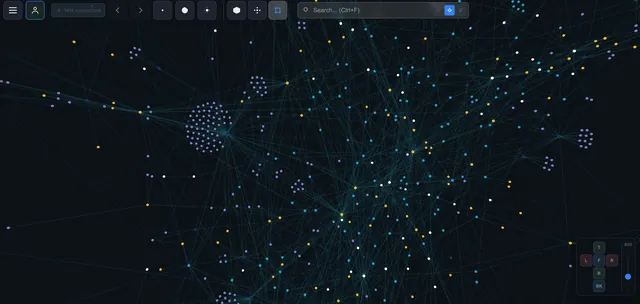
A wiki is text; its structure is a graph — pages are nodes, links are edges. Karpathy's gist itself recommends the graph view as the best way to see the shape of a growing wiki: which pages became hubs, which are orphans, where clusters form. The lint operation is literally a graph health check.
This matters even more when your LLM wiki lives in Notion, because Notion has no built-in graph view. IVGraph fills that gap: it renders your workspace — every page, backlink, and database relation — as an interactive 3D knowledge graph, so you can watch the wiki your LLM is building actually take shape. Agents can also query the same structure programmatically through the IVGraph LLM API.
FAQ
What is an LLM wiki in simple terms?
A knowledge base your AI builds and maintains for you. You feed it sources and questions; it writes, cross-links, and updates the pages. Compiled once, kept current — the opposite of re-searching raw files on every query.
Where is Karpathy's LLM wiki on GitHub?
It's a gist, not a repo: llm-wiki.md, published April 4, 2026. By design there's nothing to install — you paste the idea into your own agent and build your version together.
LLM wiki vs second brain — which one do I need?
They're not rivals: a second brain is the practice, an LLM wiki is what the practice becomes when the LLM takes over the maintenance. If you already keep notes, adding an agent that maintains them is the upgrade path — see the table above for how the roles split.
Do I need Obsidian for this?
No — any store the LLM can read and write works. Local markdown is the lightest option; Notion via MCP is the natural one if your knowledge already lives there (and gives you databases and collaboration on top).